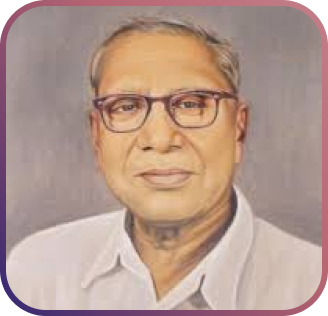
- Rai Bahadur Ranada Prasad Shaha
- Entrepreneur | Philanthropist | Social worker | Soldier
- Kumudini Welfare Trust of Bengal Ltd.
- Other Names: R.P. Shaha
- Born: 15 November 1896
- Birth Place: Savar, Bengal, British India
- Abducted: 7 May 1971 (aged 74)
- Abducted from: Mirzapur, Dhaka, Bangladesh
- Awards: Independence Award (1978), British War Medal (1919), Sword of Honour (1919)
- Battles/wars: World War I, Mesopotamian campaign
Overview
Rai Bahadur Ranada Prasad Saha (Bengali: রণদা প্রসাদ সাহা), also
known as R. P. Saha, was a Bengali businessman, entrepreneur,
soldier, philanthropist, social worker, and humanitarian. He
founded educational institutes like Bharateswari Homes, Kumudini
College and Debendra College. On 7 May 1971, the collaborators
of Pakistani occupation army abducted RP Saha and his son Bhavani
Prasad Saha from Mirzapur and no news about their whereabout has
been unearthed till now Shaha was born on 15 November
1896. Debendranath Podder, Shaha's father, originated
from Mirzapur in Tangail subdivision in Mymensingh District. Shaha
was born in his maternal uncle's house at Kachhur in Savar,
near Dhaka. At the age of seven, he lost his mother, Kumudini
Devi, who died of tetanus during childbirth. At the age of
sixteen, he fled to Kolkata and initially worked as a canteen boy
and hawker.
Early life
Shaha joined the Bengal Ambulance Corps as a medic and went to
the World War I. He left Kolkata in 1915 for Mesopotamia. He
earned a medal and citation from King George the Fifth for his
distinctive performance. Later he got commission as Vice Roy
Commissioned officer in the 49 Bengal Regiment. He got a job in
the Indian Railway department as a war veteran. He was honored for
saving some British officers from a camp fire. After serving for
about five years, Shaha retired from the army and served British
Railway as a ticket collector until 1931.[3] In 1932, he started
his coal business. He later acquired a dealership for coal
business in Kolkata. In four years, he became a well-established
coal businessman in Kolkata. He diversified his business in
different sectors including passenger launch, river transport,
dockyard, food grain, and jute. He bought a ship named Bengal
River.[1] He was appointed one of the agents to buy food grains
for the Government. He bought three powerhouses at Narayanganj,
Mymensingh and Comilla and owned the George Anderson Company of
Narayanganj that used to make jute bales.
“A poor man became a millionaire, and the millionaire voluntarily
became a poor man, spending his all in the service of humanity,
for the suffering and the distressed, for the furtherance of
education, for rendering a service to the state, which the state
itself has not undertaken. But is the Rai Bahadur poor; he is rich
in the esteem, in the affection, in the love of a grateful people;
having given all his worldly possessions, he has obtained more
than those who were his compeers. May that state and the people he
has served so well give him that recognition which is his due, and
not destroy the great institution he has built with such love and
devotion. ”
Philanthropy
In 1938, Shaha founded a charitable hospital at his native village
Mirzapur on the river Lauhajang. On 27 July 1944 the hospital
which had 20 beds was opened by Richard Casey, Baron Casey, the
then Governor of Bengal.[4] Saha named it Kumudini Hospital, after
his mother Kumudini whose suffering from lack of medical care
inspired him to establish a hospital for the poor, so that people,
especially women, would not suffer the way his mother had. During
the famine of 1943–1944, he maintained 275 gruel houses to feed
the hungry for 8 months. As of 2010, the hospital has 750 beds and
continues to serve the poor, providing them with free beds, meals
and treatment and charging only nominally for surgical procedures.
If the hospital was flooded, Ranadaprasad made the doctor's
treat the patients on the top floors. He didn't care about
death rates as many hospitals did and made sure no one was ever
turned back. The Maternity Wing of the Dhaka Combined Military
Hospital was established with his financial support.[citation
needed] To spread female education he founded in 1942 a fully
residential school at Mirzapur and named it Bharateswari
Bidyapith after Bharateswari Devi, his grandmother. In 1945, this
institution was renamed to Bharateswari Homes. It has 1200 seats
as of 2010 and is renowned for producing well-rounded, socially
responsible students who have gone on to excel in their respective
fields. Founded the Kumudini College at Tangail in 1943
and Debendra College at Manikganj District in 1944 to commemorate
his mother and father respectively. He also set up the Mirzapur
Pilot Boys' School, Mirzapur Pilot Girls' School, and
Mirzapur Degree College. In 1947, Saha placed all his companies in
a trust by the name of Kumudini Welfare Trust (KWT), with the
earnings from the income generating activities such as jute baling
press and a river transportation business, being used to run the
welfare activities. The full extent of his philanthropic
activities is not known even by his own family. In 1944, he
donated BDT 250,000 to the Red Cross. His family often learns
about them when they receive letters or calls from organizations
informing them about some large donations he had made or some way
in which he had helped them.
Abduction
In April 1971, during the Liberation War of Bangladesh, despite a
good working relationship with the Pakistani authorities as well
as all preceding and successive governments, Saha, with his
26-year-old son Bhavani Prasad Saha, was picked up by
the Pakistani occupation army. They returned home after about a
week, but were picked up again a day later on 7 May, after which
they were never heard from again. Saha's daughter-in-law,
Srimati Saha, was widowed at the age of 20, four years into her
marriage. Her only child, son Rajiv, was three years old at the
time. The death of Ranada Prasad Saha remained a mystery as his
body was never found, and neither was his son's.
Awards & Honours
In appreciation of his humanitarian work the British Government
conferred on Saha the title of Rai Bahadur.[1] In 1978, he was
posthumously awarded the Independence day award by the Government
of Bangladesh as a recognition of his social works.